

Dili, September 25, 2026
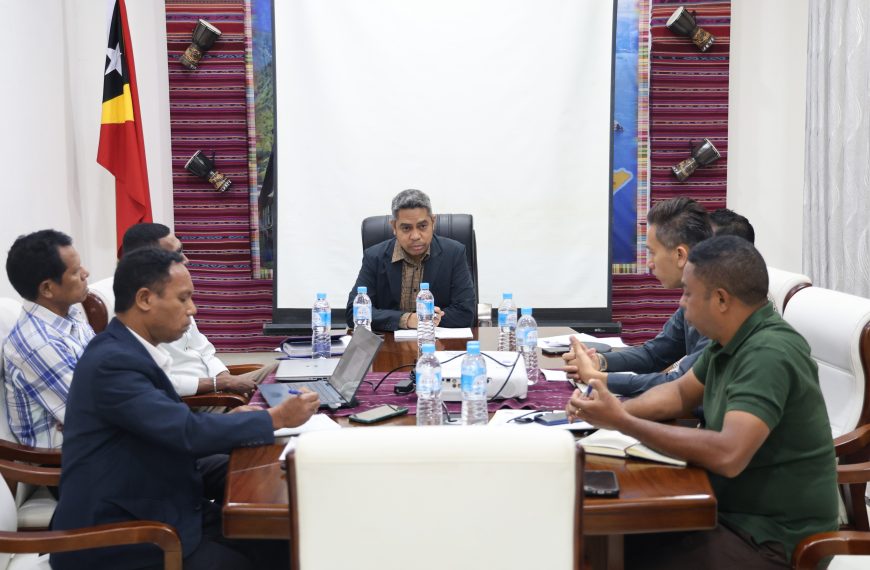
The Coordinating Minister for Economic Affairs (MKAE), represented by General Coordinator Mr. Jorge Rui de Carvalho Martins, chaired a meeting with relevant stakeholders to review Decree-Law No. 37/2020 on Zero Plastic. The meeting took place in the conference room of the Cabinet of the MKAE, at the Government Palace in Dili.
The objective of the meeting focused on evaluating the implementation of the Zero Plastic Law, identifying operational challenges on the ground, and discussing potential amendments necessary to strengthen the law’s effectiveness.
In his address, the General Coordinator of MKAE emphasized that any revision to the Zero Plastic policy must account for operational realities in the field.
“We are gathered today to review the policy regarding Zero Plastic. As we know, in practice, the law’s implementation has presented various challenges on the ground,” stated General Coordinator Martins.
He noted that during a seminar organized by TradeInvest two years ago, both he and the Director of Pollution Control faced various criticisms regarding the law’s enforcement. Consequently, His Excellency the Vice Prime Minister, serving as Minister of Tourism and Environment, committed to conducting an evaluation and introducing the necessary amendments.
“First, in practice, plastic pollution has not decreased; rather, it continues to rise. This raises a fundamental question: Is this issue rooted in the framing of the law itself, or does it stem from a lack of institutional capacity to execute it?” the General Coordinator remarked.
He further questioned whether the priorities outlined in the law require adjustment. According to Mr. Martins, a comprehensive analysis of the matter must account for regional market integration and Timor-Leste’s goal to solidify its position within ASEAN.
“By 2028, agricultural, non-agricultural, manufactured, and industrial products will enter Timor-Leste through its ports, airports, and borders under zero-tariff conditions. Therefore, we must re-evaluate our laws and regulatory frameworks to ensure they provide technical advantages that enable the Government to develop the economy while protecting the local market,” he explained.
The General Coordinator also referenced the principle of non-discrimination and equal treatment among trading partners, including Technical Barriers to Trade (TBT).
He underlined that Timor-Leste, as a member of the World Trade Organization (WTO), needs to review its legislation and regulatory systems accordingly.
Addressing decisions taken last year, the General Coordinator noted that stakeholders had considered three options regarding the legislation, ultimately selecting the final option. Under this option, regardless of packaging or product category, any material containing plastic components will be subject to fines. Products may be exempt from customs tariffs, but violations of the law will incur penalties.
“This is an issue we must thoroughly debate before launching a public consultation process with both the public and the private sector,” he said.
The meeting also addressed private sector responsibility, public awareness, and community commitment to minimizing reliance on single-use plastics. Stakeholders agreed that effective implementation requires strong coordination among all relevant institutions.
The implementation of the Zero Plastic Law is considered a key component of ongoing efforts to reduce single-use plastic reliance and waste accumulation, promote sustainable practices, and prevent environmental pollution.
As such, the law serves as a vital instrument for protecting the environment, enhancing waste management systems, and fostering behavioral change across the community. Inter-institutional coordination—particularly among the National Directorate for Pollution Control, the National Agency for Environmental Licensing (ANLA, IP), and other key entities—will remain paramount to ensuring the fulfillment of statutory mandates.
The meeting drew high-level participation from key institutions, including the Ministry of Tourism and Environment, the Ministry of Commerce and Industry, AIFAESA, the Timor-Leste Tourism Authority, and the National Customs Authority.