

Díli, 4 February 2026 —
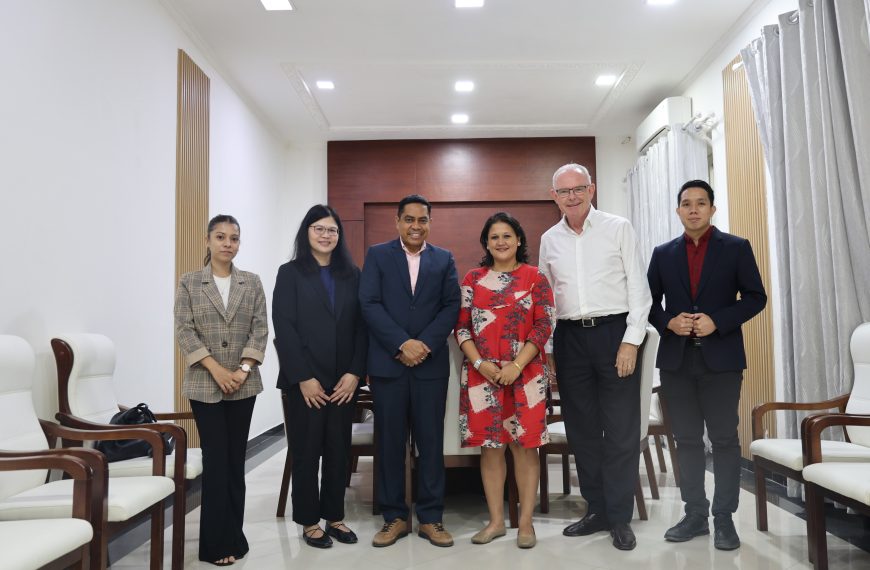
The Office of the Coordinating Minister for Economic Affairs, through the General Coordinator, Jorge Rui de Carvalho Martins, held a meeting with the International Finance Corporation (IFC) and the World Bank to discuss the Tourism Deep Dive initiative under the Country Private Sector Diagnostic (CPSD) for Timor-Leste. The meeting took place at the Government Palace in Díli.
During the discussion, the Government highlighted a fundamental shift in its economic approach—from acting as a direct operator to serving as a strategic facilitator. This transformation aims to create an enabling environment for the private sector to lead economic development, particularly in the tourism and ICT sectors, with a strong focus on resources, market access, and human capital development.
In the tourism sector, Timor-Leste prioritizes specialized ecological tourism, religious tourism, and community-based tourism. Key initiatives include the development of religious tourism at Tasi-Tolu and the establishment of MICE (Meetings, Incentives, Conferences and Exhibitions) infrastructure aligned with ASEAN standards.
The General Coordinator highlighted market imbalances in the whale-watching tourism sector, noting that international tour operators charge packages of up to USD 3,000 while Timor-Leste captures only a minimal share of the revenue. To address this, the Government is diversifying tourism products, including sea turtle observation and the development of local culinary centers in Maubisse and Ainaro, to enhance local value creation.
To support private sector-led growth, the Government is implementing key economic reforms, including the Money Guarantee Law and the Insolvency Law, while improving access to finance for local entrepreneurs through BNCTL. These reforms are complemented by infrastructure priorities such as improved connectivity, desalination technology in Atauro, and the Manaboot Agricultural Project, aimed at strengthening food security by 2028.
The Government also emphasized its commitment to community-based guesthouses, rather than government-run lodges, to ensure that economic benefits reach local communities directly. This approach is supported by vocational training programs in Tibar and Becora, providing hospitality certification aligned with international standards.
“By strengthening inclusive development and investing in human capital, Timor-Leste aims to position itself as a competitive, sustainable, and integrated tourism destination within the ASEAN region,” concluded the General Coordinator of MCAE